
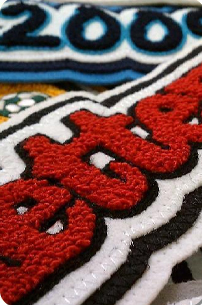
Compare chenille embroidery for your garment brief: Letter patches and decorative emblems on varsity jackets and sweatshirts. Confirm the proposed specification on a physical sample.
Looped or pile-like stitches create a plush surface, often combined with felt, borders or other stitches to form letter patches.
What to compare in the image
The samples shows overlapping loops with a towel-like texture. Compared with the aligned stitches of flat embroidery and the dense covering of 3D embroidery, chenille emphasises pile and volume.
Properties and limitations
Large letters and simple blocks are useful applications. Loops can obscure tiny text or fine lines; check loop security, borders and the patch attachment method.
External visual samples, not a factory sample.
How to specify chenille embroidery
Review stitch direction, density, thread, backing and the inside finish on the actual garment fabric. Small letters and dense filled areas may need simplification or a different scale. Check puckering, distortion and skin contact after the agreed care cycle; a digital embroidery file is not a finished approval sample.
What to send for sampling and a quotation
- Garment samples, intended wear and destination market.
- Material composition, weight, colour and the proposed finish.
- Quantity by style and colour, target timing and approval responsibility.
- Artwork dimensions and placement; measurement and care requirements.
Sample approval and repeat orders
Keep the approved material or decorated garment, its revision and the agreed check results together. For a repeat order, confirm the material lot, shade, artwork version and current conditions again. Price, minimums and schedule follow the actual specification; photographs show appearance and do not establish tested performance.
Compare fabric options · Compare decoration options · Prepare a development brief · Agree inspection requirements